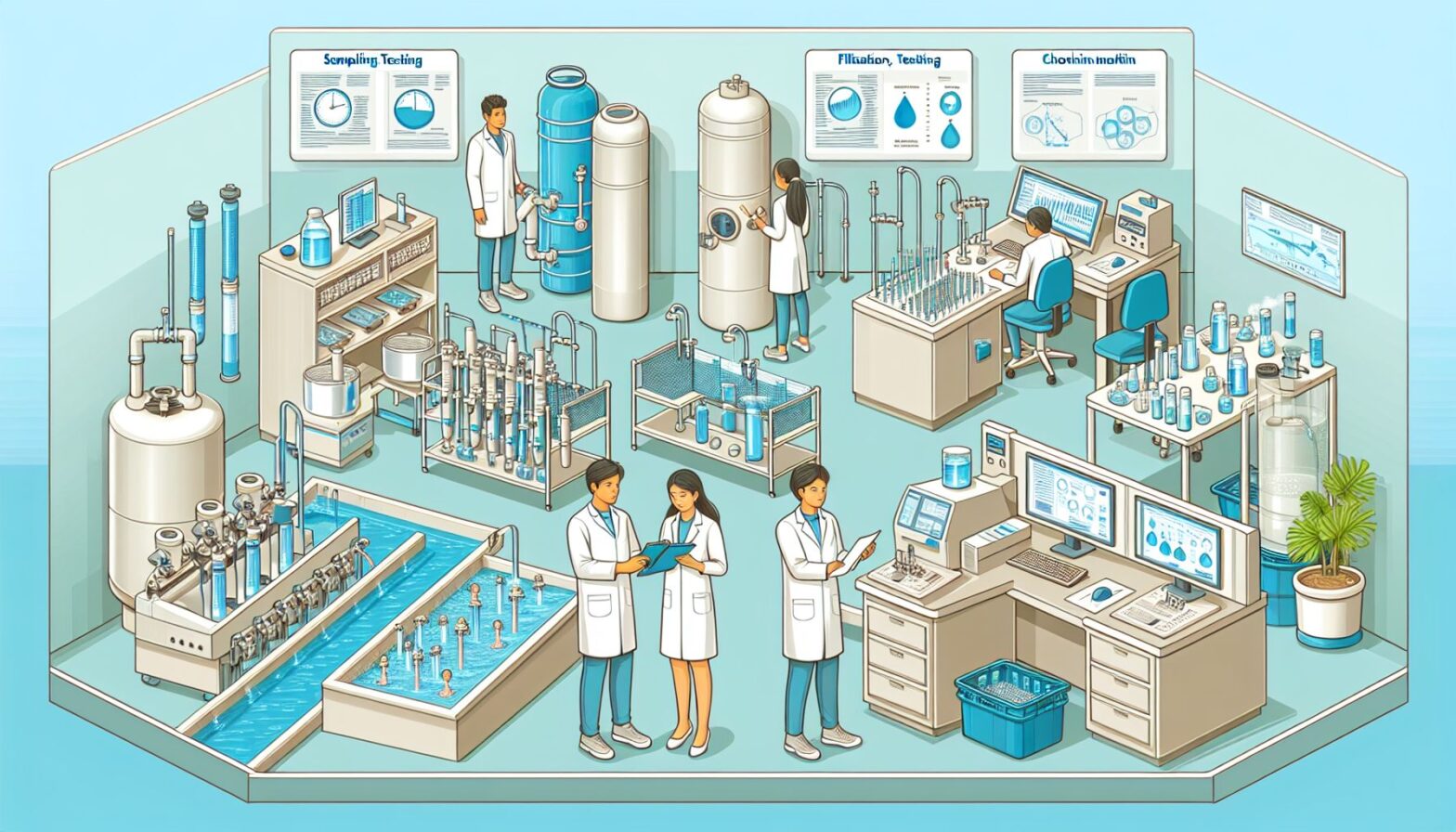
Access to safe, quality drinking water is a human right enshrined in international law. Municipal water suppliers’ responsibility to society involves ensuring the provision of clean, safe, and affordable water to all. Complex enough? Wait until we really get into the system that enables this feat: municipal water quality monitoring and treatment optimization.
An Overview of Municipal Water Quality Monitoring
Let’s start at the beginning. What is municipal water quality monitoring, and why is it significant?
Water quality monitoring is the process of regular assessment of the water’s physical, chemical, biological, and radiological characteristics. This is performed extensively to ensure that water supplied for domestic use, including drinking, bathing, and cooking, maintains public health standards and complies with regulatory specifications.
Municipal water quality monitoring requires a systematic approach. It’s similar to a doctor who conducts physical check-ups or evaluates blood reports to diagnose and treat an illness. This process includes regular testing of source water, treatment process water, and distribution system water.
Regulatory Requirements and Environmental Protection
Each country and its states or provinces have regulatory bodies that enact water quality standards. In the US, the Environmental Protection Agency (EPA) governs legal compliance. The Safe Drinking Water Act (SDWA) of 1974 is the principal federal law that protects public drinking water supplies in the nation.
On a state level, consider the New York water quality standards. They serve as a benchmark, dictating allowable water contaminant levels and providing procedures for regular monitoring and testing. Regularly tallying analysis results with these standards helps ensure adequate water quality and regulatory compliance.
Water Quality Indicators and their Importance
A variety of parameters signify the water quality status.
-
Bacterial indicators: Fecal coliform and Escherichia coli (E. coli) are primary bacterial indicators to assess microbial contamination.
-
Chemical indicators: Common contaminants include nitrate, lead, copper, chloride, fluoride, sulfate, and various organic compounds.
-
Physical indicators: It involves testing the water’s color, odor, temperature, turbidity, and pH level.
-
Radiological indicators: Radon, radium, and other radioactive contaminants are measured for their potential health risks.
So, why are these indicators vital? Each of these contaminants carries potential health risks, from gastrointestinal disorders to neurological damage and cancer. Hence, their regular monitoring is essential for public health safety.
Treatment Optimization – A Key to Enhanced Water Sanitation
Water quality monitoring is half the story – what follows next is treatment optimization. This process aims to maximize water treatment efficiency and achieve water quality that surpasses the baseline regulatory requirements.
Treatment optimization involves adopting innovative methods and technologies. It includes not only conventional techniques like coagulation, sedimentation, filtration, and disinfection but also advanced processes like membrane filtration, UV radiation, and advanced oxidation processes (AOPs).
Case Study – Use of Data-Driven Approach for Treatment Optimization
Philadelphia Water Department gives an inspiring example in this line. Their approach to wastewater treatment optimization involves using machine learning, predictive analytics, and real-time data to anticipate potential water quality problems before they occur. It’s this proactive approach which makes a difference in securing the water future of their city dwellers.
The Road Driven by Emerging Challenges and Future Trends
While the basic principles of municipal water quality monitoring and treatment optimization remain unchanged, their execution confronts timely challenges.
Population growth and urbanization, coupled with climate change impacts, strain the water resources. Illegal waste disposal and agricultural runoffs escalate the water contamination risk, demanding efficient monitoring systems.
On the technology front, the rise of digital tools, artificial intelligence, and the Internet of Things (IoT) are reshaping the water industry.
Sensor-based IoT solutions promise automated and real-time monitoring, which significantly reduces human errors. Meanwhile, AI and machine learning can make predictive analytics a norm in the water sector, ensuring proactive, rather than reactive, measures.
Such tools blend with conventional water science to enhance monitoring accuracy, improve treatment efficiency, and ensure regulatory compliance smartly and effectively.
They also push the boundaries, making the once-distant concept of “smart water cities” a reality now knocking at the door. Not only do they ensure safe water for all, but they drive us towards a more sustainable and resilient water future.
Can we foresee a time when water crises will become history? Looking at the journey of municipal water quality monitoring and treatment optimization, we can be hopeful that we’re on the right path.
Conclusion
Municipal water quality monitoring and treatment optimization aren’t simply terms – they reflect an ongoing commitment to public health and environmental protection. This system, while complex and challenging, offers numerous opportunities for innovation and improvement.
So, while we turn the tap open and enjoy clean water flowing out, let’s appreciate the painstaking efforts put into monitoring our water quality and optimizing its treatment. After all, such vigilant commitment underpins our daily life and ensures we thrive in a healthier and safer world.